Loading...
Assign each region of your world a score from 1 to 8 in both categories (rainfall and temperature), then reference the chart below to determine the biome.
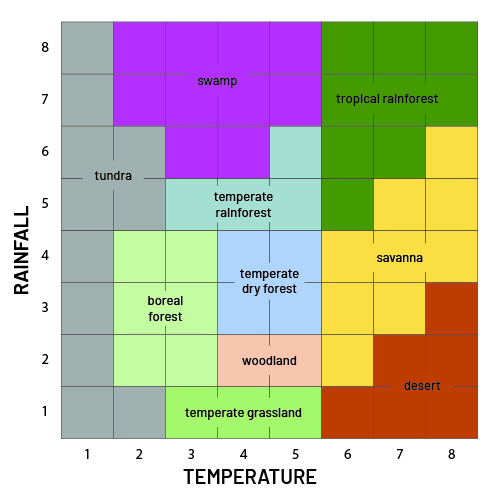
Remember: your temperature and rainfall designations need to be justified!
What Affects Rainfall?
- Distance to the Equator: Rainfall often follows patterns based on distance from the equator, with tropical areas receiving the most rain.
- Altitude: At higher altitudes, air tends to cool and can't hold as much moisture, which can lead to rain.
- Distance to the Nearest Ocean: Regions close to oceans are more likely to receive moisture (and thus rain) carried by winds from the ocean.
- Wind Patterns: Winds carry moisture over long distances, leading to rainfall when the air cools.
- Rain Shadow Effect: Mountains can cause air to rise and lose its moisture on one side (windward), leading to rainfall, and descend and warm up on the other side (leeward), leading to drier conditions.
What Affects Temperature?
- Distance to the Equator: The equator receives more direct sunlight, leading to warmer temperatures. The further from the equator, the cooler it generally becomes.
- Altitude: Higher altitudes are typically cooler due to lower air pressure and less direct sunlight.
- Distance to the Nearest Ocean: Oceans have a moderating effect on climate, leading to milder temperatures in coastal regions compared to inland regions.
- Geology and Soil Composition: The type of soil and underlying geology can influence how much sunlight is absorbed or reflected back into the atmosphere, affecting temperature.
Read the rest for free
Enter your email and we'll send you a sign-in link. It unlocks this page and all 78 free tools. No password.
Assign each region of your world a score from 1 to 8 in both categories (rainfall and temperature), then reference the chart below to determine the biome.
Remember: your temperature and rainfall designations need to be justified!
What Affects Rainfall?
- Distance to the Equator: Rainfall often follows patterns based on distance from the equator, with tropical areas receiving the most rain.
- Altitude: At higher altitudes, air tends to cool and can't hold as much moisture, which can lead to rain.
- Distance to the Nearest Ocean: Regions close to oceans are more likely to receive moisture (and thus rain) carried by winds from the ocean.
- Wind Patterns: Winds carry moisture over long distances, leading to rainfall when the air cools.
- Rain Shadow Effect: Mountains can cause air to rise and lose its moisture on one side (windward), leading to rainfall, and descend and warm up on the other side (leeward), leading to drier conditions.
What Affects Temperature?
- Distance to the Equator: The equator receives more direct sunlight, leading to warmer temperatures. The further from the equator, the cooler it generally becomes.
- Altitude: Higher altitudes are typically cooler due to lower air pressure and less direct sunlight.
- Distance to the Nearest Ocean: Oceans have a moderating effect on climate, leading to milder temperatures in coastal regions compared to inland regions.
- Geology and Soil Composition: The type of soil and underlying geology can influence how much sunlight is absorbed or reflected back into the atmosphere, affecting temperature.
- Man-made Factors: Human activity, such as urban heat islands, deforestation, and greenhouse gas emissions, can affect local and global temperatures.
Tundra
The tundra is a cold, treeless region found in the polar regions of the earth. It is characterized by long, cold winters and short, cool summers. The ground is permanently frozen (permafrost) and the vegetation is sparse, consisting mainly of mosses, lichens, and low-growing shrubs.
Temperate Grassland
Temperate grasslands are found in regions with moderate temperatures. They are characterized by rolling hills and grasses that can reach up to a meter in height. Trees are scarce in these regions and the soil is often deep.
Desert
Deserts are dry, arid regions with sparse vegetation and extreme heat. Deserts receive very little rainfall and the vegetation that does exist is adapted to survive with minimal water.
Boreal Forest
Boreal forests, also known as taiga, are found in the northern parts of North America, Europe, and Asia. They are characterized by coniferous trees, long cold winters, and short cool summers. The soil is typically thin and nutrient-poor, but the trees are able to thrive due to the long growing season.
Woodland
Woodlands are areas with a mix of trees and open space. They can be found in a variety of climates and can range from dense forests to more open, park-like settings. The vegetation in woodlands is typically a mix of trees, shrubs, and grasses.
Savanna
Savannas are grassland regions with scattered trees. They are found in tropical and subtropical regions and have a distinct dry season followed by a rainy season. The vegetation is typically grasses and trees with long roots that can reach underground water sources.
Temperate Dry Forest
Temperate dry forests are found in regions with moderate temperatures and low to moderate rainfall. They are characterized by a mix of deciduous and evergreen trees and a distinct dry season. The soil is often nutrient-poor and the trees have adapted to survive with minimal water.
Temperate Rainforest
Temperate rainforests are found in regions with high rainfall and moderate temperatures. They are characterized by a dense canopy of tall trees and a high level of biodiversity. The soil is typically rich and moist, supporting a wide variety of plant and animal life.
Swamp
Swamps are wetland regions that are flooded for at least part of the year. They can be found in a variety of climates and are characterized by slow-moving water, wet soil, and a diverse mix of plant and animal life.
Tropical Rainforest
Tropical rainforests are found in the equatorial regions of the world and are characterized by high rainfall and high humidity. They are home to a wide variety of plant and animal life and have a dense canopy of tall trees. The soil is typically rich and moist, supporting a diverse range of plant life.
Earth References
Related Resources
150+ Seamless Biome & Parchment Textures
A curated collection of seamless biome and parchment textures for worldbuilders, GMs, and artists....
Inkarnate World Map Aesthetic Guide
A step-by-step guide to one world-map look in Inkarnate, with the exact filter, Land Tool, river,...
16 Domains of Worldbuilding
A checklist of what a fictional world is made of: 16 domains in four groups, from the sky and the...