Loading...
The Skill vs. Challenge Model is a psychological framework that describes our emotional state based on two factors: how skilled we feel and how challenging a task is. The ultimate goal is often to reach a state of "Flow" — a perfect immersion in a task where skill and challenge are in harmony. For writers, this model is useful for plotting a character's journey, creating emotional resonance, and ensuring your story's challenges escalate in a satisfying way.
Note: The state of 'Flow' is the ultimate goal of this model. For a deeper dive, see our resource on the 7 Conditions for Flow.
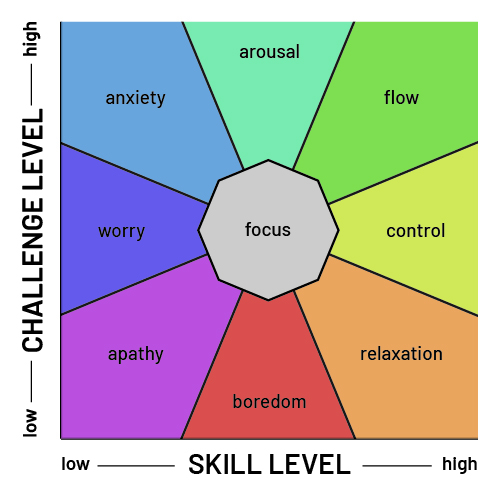
The 9 States of Engagement
Anxiety
Low Skill, High Challenge
Overwhelmed and stressed. The task feels impossible.
Arousal
Moderate Skill, High Challenge
Energized and vigilant. The task is exciting but demanding.
Flow
High Skill, High Challenge
Completely immersed and "in the zone." Effortless action.
Worry
Low Skill, Moderate Challenge
Concerned and uncertain. The task is daunting.
Focus
Moderate Skill, Moderate Challenge
Engaged and concentrating. The task is manageable.
Control
High Skill, Moderate Challenge
Confident and in command. The task is well within grasp.
Apathy
Low Skill, Low Challenge
Uninterested and detached. The task is meaningless.
Boredom
Moderate Skill, Low Challenge
Unstimulated and restless. The task is too easy.
Relaxation
High Skill, Low Challenge
At ease and calm. The task is second nature.
Read the rest for free
Enter your email and we'll send you a sign-in link. It unlocks this page and all 78 free tools. No password.
The Skill vs. Challenge Model is a psychological framework that describes our emotional state based on two factors: how skilled we feel and how challenging a task is. The ultimate goal is often to reach a state of "Flow" — a perfect immersion in a task where skill and challenge are in harmony. For writers, this model is useful for plotting a character's journey, creating emotional resonance, and ensuring your story's challenges escalate in a satisfying way.
Note: The state of 'Flow' is the ultimate goal of this model. For a deeper dive, see our resource on the 7 Conditions for Flow.
The 9 States of Engagement
Anxiety
Low Skill, High Challenge
Overwhelmed and stressed. The task feels impossible.
Arousal
Moderate Skill, High Challenge
Energized and vigilant. The task is exciting but demanding.
Flow
High Skill, High Challenge
Completely immersed and "in the zone." Effortless action.
Worry
Low Skill, Moderate Challenge
Concerned and uncertain. The task is daunting.
Focus
Moderate Skill, Moderate Challenge
Engaged and concentrating. The task is manageable.
Control
High Skill, Moderate Challenge
Confident and in command. The task is well within grasp.
Apathy
Low Skill, Low Challenge
Uninterested and detached. The task is meaningless.
Boredom
Moderate Skill, Low Challenge
Unstimulated and restless. The task is too easy.
Relaxation
High Skill, Low Challenge
At ease and calm. The task is second nature.
Plotting with the Skill vs. Challenge Model
Mapping a Character's Journey
The model provides a perfect structure for a character arc. A hero's journey is often a movement across this grid, from the bottom left to the top right.
- Act 1: Apathy & Anxiety. The hero starts with low skill. They are either in Apathy (a farm boy staring at the horizon) or thrown into Anxiety by the inciting incident (the farm is attacked by dragons).
- Act 2: Worry, Boredom & Arousal. This is the training and rising action. The hero faces new tests, moving between Worry (first time sparring), Boredom (endless drills), and moments of Arousal as their skills grow to meet bigger challenges.
- Act 3: Control & Flow. In the climax, the hero has mastered their skills. They may enter a state of Control against the villain's lieutenants, but must achieve perfect Flow to defeat the final boss, where the challenge is at its absolute peak.
Creating Specific Scenes and Subplots
Use the other states to create specific scenes that reveal character and advance the plot.
- Boredom: Show a master assassin (high skill) forced to take a simple bodyguard job (low challenge). Their boredom leads them to take a risk, which kicks off a new subplot.
- Control: Before the final battle, show the hero in a state of Control during a smaller skirmish. This demonstrates their competence to the audience and builds anticipation for the true test to come.
- Anxiety: Create a "nightmare" scenario for your hero by putting them in a situation where they have no skills (e.g., a warrior forced into a political negotiation, or a diplomat forced to fight). This is a great way to reveal their vulnerabilities.
Related Resources
7 Conditions for Flow
Understand the peak state of focus known as 'flow.' This guide covers the 7 conditions required to...
The Pacing Rhythm Blueprint
Controlling story tempo: when to accelerate, when to breathe, and why. 11 frameworks and 71...
Premium5 Blueprints for Building Encounters
Build memorable encounters with five structural blueprints: Combat, Social, Investigation,...
Premium